
Process engineering
From process basis to an integrated production line
A controlled engineering workflow that connects requirements, process design, equipment duties, interfaces, acceptance evidence and plant integration.
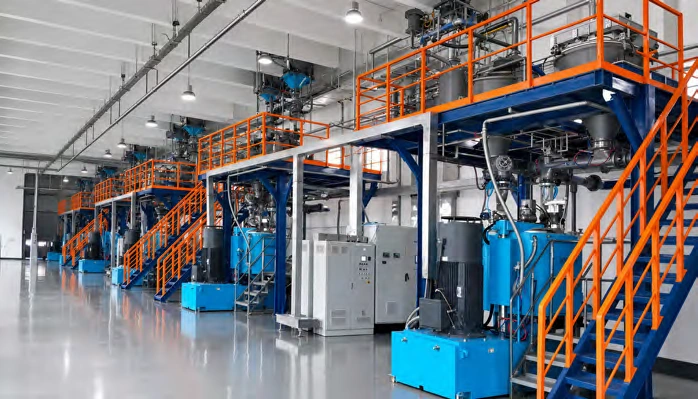
An integrated production line is not created by placing individually suitable machines in sequence. It is created by converting the product and process objectives into a controlled design basis, defining every unit-operation duty, assigning every interface, and carrying those requirements through FAT, site integration and performance acceptance.
Build a deliverable ladder, not a stack of disconnected documents
Each engineering document should answer a different question and pass controlled information to the next decision.
ISO 10628 provides internationally recognised principles for diagrams used in chemical and petrochemical process industries. The value of a BFD or PFD is not aesthetic: it establishes a common process model from which duties, interfaces and test evidence can be traced.
- 01 · Requirements
Product, feed, capacity, quality, operating mode and site constraints
- 02 · Design basis
Assumptions, balances, utilities, control philosophy and acceptance boundaries
- 03 · Process route
BFD / PFD, recycle logic, emissions and critical unit operations
- 04 · Equipment duties
Function, material properties, turndown, containment and cleanability
- 05 · Integration
Layout, piping, utilities, controls, access, maintenance and safety interfaces
- 06 · FAT
Document, fabrication, functional and agreed material-trial evidence
- 07 · SAT & performance
Installed functionality, product performance and controlled close-out
Sources: S1
Control the interfaces that no equipment data sheet owns
Many line-level failures occur between technically acceptable packages.
| Interface | Questions to close | Acceptance evidence |
|---|---|---|
| Material transfer | Flow regime, segregation, bridging, dust, temperature and hold-up | Transfer trial, inspection and clean-out evidence |
| Utilities | Load, quality, pressure, diversity, peaks and failure behavior | Consumption schedule and functional test |
| Controls | Signals, permissives, interlocks, alarm ownership and recipe handover | I/O test and cause-and-effect record |
| Mechanical | Loads, nozzles, access, lifting, maintenance and thermal movement | Interface drawing and installation check |
| Quality & cleaning | Residue limits, cross-contamination, drainage and inspection access | Cleaning protocol and verification method |
| Safety | Hazards, zones, isolation, guarding, pressure relief and emergency state | Risk assessment and safety-function test |
Integrate compliance while the line is still changeable
Compliance is a design input, not a document package added after fabrication.
Regulation (EU) 2023/1230 on machinery applies from 20 January 2027. For equipment intended for potentially explosive atmospheres, the ATEX framework may also govern equipment and protective systems. Applicability depends on the machine, material, atmosphere, installation and destination market.
Risk architecture
Define machine boundaries, intended use, foreseeable misuse and interfaces between assemblies.
Material hazards
Assess dust explosibility, chemical compatibility, thermal decomposition and occupational exposure.
Documentation
Keep declarations, manuals, safety functions and technical evidence aligned with the delivered configuration.
Change control
Reassess compliance when throughput, product, layout, controls or package boundaries change.
Keep one requirements-and-deviation thread through every phase
A production line changes during design; uncontrolled change is what breaks traceability.
The design basis should identify assumptions that still require confirmation. When a supplier proposes a different material, nozzle arrangement, utility condition or control sequence, the change needs an owner, technical disposition and impact review across process performance, safety, schedule, cost and acceptance.
The same register should survive package award. Closing a comment in a drawing is not enough if the affected requirement, interface, test or operating document remains unchanged.
| Field | Required content | Downstream control |
|---|---|---|
| Origin | Requirement, design review, supplier deviation, site discovery or test result | Preserves why the change exists |
| Technical impact | Process, mechanical, electrical, control, safety, quality and maintenance effects | Prevents local optimisation from moving risk elsewhere |
| Commercial impact | Price, schedule, warranty, performance and scope boundary | Avoids silent transfer of responsibility |
| Documents | Drawings, calculations, lists, manuals and test protocols affected | Keeps the delivered baseline coherent |
| Closure | Approver, evidence, date and residual action | Creates an auditable handover |
Write the acceptance logic before issuing purchase orders
A test is useful only when feed, duration, method, tolerance and consequence are defined.
| Gate | Typical evidence | Decision |
|---|---|---|
| Design review | Approved basis, calculations, drawings and deviation register | Safe to release for manufacture |
| Fabrication review | Material certificates, weld / finish records and inspection | Conforms to approved design |
| FAT | Functional sequence, instruments, interlocks and agreed duty simulation | Safe to ship |
| SAT | Installation, utilities, I/O and site-function evidence | Safe to commission |
| Performance run | Defined feed, steady state, sampling, analysis and balance | Meets contracted process outcome |
Evidence and sources
- S1ISO 10628-1: Diagrams for the chemical and petrochemical industry ↗
International Organization for Standardization · 2014
- S2Regulation (EU) 2023/1230 on machinery ↗
EUR-Lex · 2023
- S3Equipment for potentially explosive atmospheres (ATEX) ↗
European Commission · 2026
Numerical values are presented with their regulatory or study context. Study conditions are not represented as universal commercial setpoints. EQM engineering frameworks are identified separately from cited external facts.
Frequently asked questions
Can EQM integrate equipment from different suppliers?
Yes, provided package boundaries, duties, interfaces, control ownership, documentation and acceptance evidence are explicitly managed.
Is FAT the final proof of process performance?
Usually not. FAT verifies agreed factory-level scope. Full process performance may require defined material, site utilities and sustained operation, which belong in a separate performance protocol.