
Pilot & scale-up
Pilot-plant scale-up for advanced-material processes
How a question-led pilot programme converts material behaviour into defensible process, equipment and scale-up decisions.
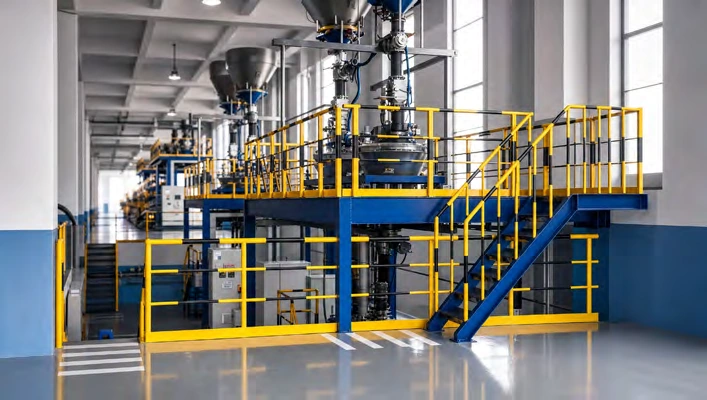
A pilot plant should not be a miniature factory built before the key questions are known. It should be an evidence system: each trial closes a defined uncertainty about chemistry, mixing, filtration, drying, powder handling, control or continuous operation, and converts the result into an industrial design rule.
Separate technology readiness from manufacturing readiness
A process can work technically while the production system remains unproven.
DOE's TRL framework distinguishes a system or subsystem prototype demonstrated in a relevant environment at TRL 6 from a system prototype demonstrated in an operational environment at TRL 7. Manufacturing Readiness Levels add a different question: can the product and process be made repeatedly, at the required quality and cost, with a capable supply and production system?
MRL 8 describes a pilot line capability demonstrated and ready to begin low-rate production. A project should not assume that strong laboratory chemistry automatically establishes manufacturing readiness.
Define the scale-up question before defining the pilot skid
The equipment, sensors, sampling and duration should follow from the decision the trial must support.
| Uncertainty | Evidence to capture | Industrial decision |
|---|---|---|
| Reaction / precipitation | Mixing sensitivity, addition profile, residence time, pH / temperature response and particle attributes | Reactor configuration and control strategy |
| Filtration / washing | Flux, cake resistance, wash efficiency, cycle time, moisture and cloth behavior | Filter area, cycle logic and washing sequence |
| Drying | Drying curve, agglomeration, deposit, exhaust condition and product attributes | Dryer type, residence time and gas / heat duty |
| Powder transfer | Bulk density, flow, attrition, segregation, dust and cleanability | Transfer method, containment and packaging |
| Continuous operation | Yield drift, fouling, recycle accumulation, alarms and intervention frequency | Campaign length, redundancy and maintenance basis |
Produce a design-quality data pack
A pilot report should be directly usable by process and equipment engineers.
Balances
Feed, product, recycle, waste, gas and water mass balances with sampling uncertainty.
Rates & cycles
Stable throughput, batch cycle, changeover, cleaning and intervention time.
Material behaviour
Rheology, filtration, adhesion, attrition, flowability, dustiness and thermal response.
Product quality
Attributes tied to each process step and a representative analytical method.
Operating envelope
Proven range, control sensitivity, failure modes and recovery procedure.
Scale translation
Dimensionless criteria, duty correlations, vendor inputs and assumptions requiring confirmation.
Translate results with the criterion that governs each operation
Geometric scale alone rarely preserves the mechanism that controls product quality or cycle time.
Reactor scale-up may examine power per volume, impeller tip speed, Reynolds number, mixing time or gas-transfer duty; the correct priority depends on whether micromixing, suspension, heat transfer, mass transfer or shear governs the product. Filtration scales more directly from area only after cake resistance, pressure regime, compressibility and washing behavior are understood.
Drying and thermal operations add residence-time distribution, evaporation or heat duty, gas-solid contact, atmosphere and deposit behavior. Powder systems add bulk density, cohesion, attrition, segregation and dust containment. A defensible scale-up basis states which similarity criteria are preserved, which are not, and how the remaining risk will be tested.
| Operation | Candidate criterion | Why one number is insufficient |
|---|---|---|
| Agitated reaction | P/V, tip speed, Reynolds number, mixing time | Chemistry may be controlled by shear, suspension, heat transfer or local addition conditions |
| Filtration | Flux, cake resistance, pressure and wash ratio | Cake compressibility and cloth behavior can change the cycle non-linearly |
| Drying | Evaporation duty, residence distribution and outlet condition | Stickiness, agglomeration and wall deposits can set the practical limit |
| Thermal treatment | Temperature profile, atmosphere, bed depth and residence time | Phase formation and gas exchange vary with loading and furnace geometry |
| Powder handling | Bulk density, flow function, dustiness and attrition | A powder that flows at bench scale may bridge, segregate or degrade in plant transfer |
Use staged evidence to avoid an oversized first pilot
Escalate equipment and material commitment only when the previous evidence gate is closed.
- 01 · Bench screen
Map sensitivity and eliminate unworkable routes
- 02 · Unit-operation trial
Measure the critical material-equipment interaction
- 03 · Integrated pilot
Test interfaces, recycle effects and control logic
- 04 · Extended campaign
Expose drift, fouling, maintenance and quality variability
- 05 · Design freeze
Convert evidence into duty, guarantee and acceptance inputs
Evidence and sources
- S1Technology Readiness Levels ↗
U.S. Department of Energy · 2022
- S2Manufacturing Readiness Level Deskbook ↗
U.S. Department of Energy · 2020
Numerical values are presented with their regulatory or study context. Study conditions are not represented as universal commercial setpoints. EQM engineering frameworks are identified separately from cited external facts.
Frequently asked questions
Does every project need a full pilot line?
No. The programme should match the uncertainty. Some decisions can be closed by representative bench or unit-operation trials; others require an integrated and sustained campaign.
Can EQM coordinate samples and testing?
Yes. EQM can support representative sampling, international shipment coordination, test planning, equipment trials, analytical follow-up and conversion of evidence into an engineering basis.