
Equipment selection
How to select process equipment for battery-material production
A decision framework for matching reactors, separation, drying, thermal and powder-finishing equipment to a defined material and process duty.
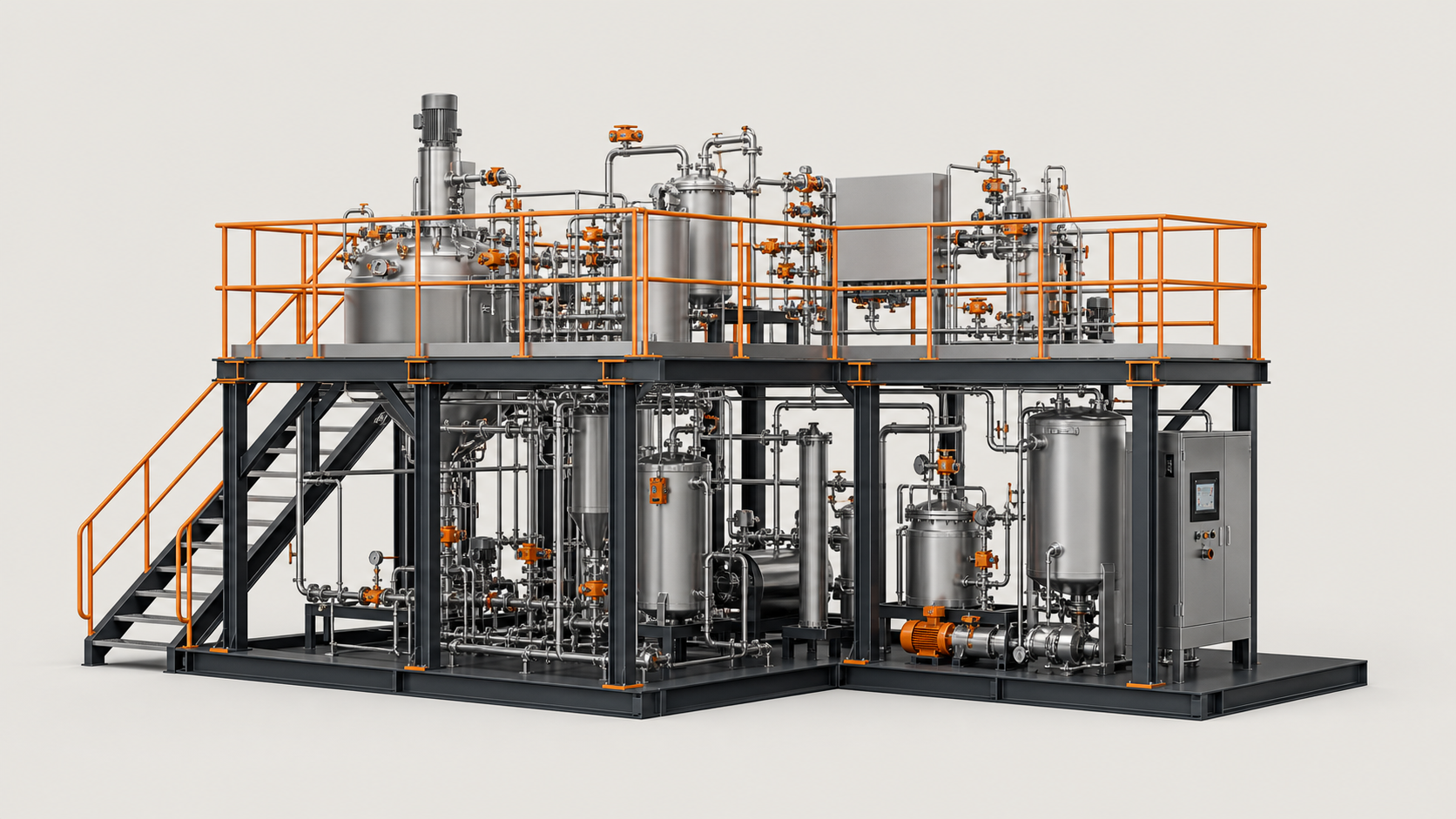
Select the process route and define the duty before selecting the machine. A credible decision connects feed variability, product specification, balances, operating window, containment, cleanability, utilities, controls and scale-up evidence—then compares vendors against the same basis.
Start with one design basis—not six vendor catalogues
Before an equipment model is discussed, the team needs a common definition of what the equipment must achieve.
The minimum basis should state feed composition and variability, target product and critical quality attributes, batch or continuous mode, capacity, operating window, utility limits, material-contact requirements, containment and cleaning philosophy. The flow diagram should show the major equipment and how mass and energy move between operations.
ISO 10628-1 defines the classification, content and representation of process flow diagrams. A controlled diagram and a single duty sheet prevent suppliers from solving different versions of the same problem.
Sources: S1
Match each machine to the governing physical duty
A familiar equipment name is not a specification. The governing variables change from reaction to filtration, drying, calcination and powder handling.
| Operation | Design variables | Evidence to request | Typical interface risk |
|---|---|---|---|
| Reaction / precipitation | Mixing, residence time, pH and temperature control | Trend data, PSD and chemistry | Local gradients or uncontrolled nucleation |
| Solid–liquid separation | Cake resistance, wash ratio and filtrate clarity | Flux / cycle curve and wash endpoint | Upstream solids create an unworkable cycle |
| Drying | Feed solids, rheology, heat sensitivity and target moisture | Moisture curve, yield and product quality | Dry product cannot be conveyed or classified |
| Thermal processing | Atmosphere, temperature profile and residence time | Phase / chemistry and temperature mapping | Off-gas, cooling or transfer bottleneck |
| Milling / finishing | PSD, contamination, containment and packaging | PSD distribution, yield and cleanability | Final quality lost during transfer or packing |
Published values are context—not universal setpoints
Battery-material literature is valuable only when chemistry, apparatus and scale stay attached to the number.
One continuous co-precipitation study for spherical LiNi0.80Co0.15Mn0.05(OH)2 used a 1 L stirred reactor at 45 °C and 500 rpm. For that experiment, the reported optimum included an NH3-to-metal molar ratio of 1.0 and pH 11.5–11.6. These are study-specific conditions, not a generic commercial design window.
A defensible specification therefore preserves material system, reactor configuration, scale, analytical method and acceptance result beside every parameter. Literature values should define trial hypotheses; industrial setpoints require representative evidence.
Review the line as an integrated system
A technically suitable machine can fail when the next operation cannot accept its output.
Material transfer
Define solids concentration, rheology, temperature, particle fragility and hold-up.
Utilities and controls
Check normal and peak loads, control authority, interlocks and safe states.
Containment
Resolve dust, vapour and cleaning boundaries; combustible dust can introduce ATEX scope.
Maintainability
Confirm isolation, access, drainage, cleaning verification and consumable replacement.
Convert technical requirements into a comparable bid sheet
Commercial comparison becomes meaningful only after every supplier responds to the same duty, boundary and acceptance case.
A useful bid sheet separates mandatory requirements from preferences and records every supplier exception. Capacity should be stated together with feed condition, operating hours, availability basis and product specification; a nameplate throughput without those qualifiers is not comparable.
The evaluation should also distinguish proven performance from proposed performance. Reference data, representative trials and calculated scale-up each carry a different level of evidence. The selected configuration should preserve those distinctions through contract scope and acceptance testing.
| Decision field | What the bidder must state | Typical hidden gap |
|---|---|---|
| Duty & capacity | Feed range, product target, operating mode, turndown and availability basis | Different suppliers size against different annual hours or feed condition |
| Performance | Guarantee value, test feed, duration, sampling and analytical method | A catalogue value is presented as a contractual guarantee |
| Scope boundary | Included equipment, instruments, controls, piping, platforms and installation services | Interfaces are excluded without an owner |
| Utilities | Normal, peak and quality requirements at the defined battery limit | Peak loads or conditioning systems appear after award |
| Lifecycle | Wear parts, cleaning, maintenance access, consumables, spares and service response | Lowest capital price creates the highest operating burden |
| Evidence status | Reference, trial, calculation, assumption and unresolved deviation | Unverified claims are scored like demonstrated results |
Use four gates before purchase order
The procurement decision should follow a visible evidence trail.
- 01 · Basis
Approved feed, product, capacity, window and acceptance criteria
- 02 · Duty
Balances, equipment duty, materials, utilities and controls
- 03 · Interface
Layout, transfer, automation, safety and site boundaries
- 04 · Evidence
Representative tests, deviations, references and FAT / SAT plan
Evidence and sources
- S1ISO 10628-1:2014 — Diagrams for the chemical and petrochemical industry ↗
ISO · 2014; confirmed 2026
- S2Preparation of spherical LiNi0.80Co0.15Mn0.05O2 by continuous co-precipitation ↗
Journal of Power Sources · 2010
- S3Effects of process parameters on manganese-rich carbonate precursors ↗
Chemical Engineering Journal · 2021
- S4Regulation (EU) 2023/1230 on machinery ↗
EUR-Lex · 2023
- S5Equipment for potentially explosive atmospheres (ATEX) ↗
European Commission · Current guidance
Numerical values are presented with their regulatory or study context. Study conditions are not represented as universal commercial setpoints. EQM engineering frameworks are identified separately from cited external facts.
Frequently asked questions
Should equipment be selected before the process route is fixed?
Normally no. Early vendor engagement can inform the design, but the purchase decision should follow a controlled and comparable process duty.
Can Equimatix support a single machine as well as a complete line?
Yes. EQM can support one package, a skid or pilot system, or an integrated line, with scope and acceptance boundaries defined for each engagement.